
A socioecological framework for physician advocacy
Motivators, enablers, and barriers
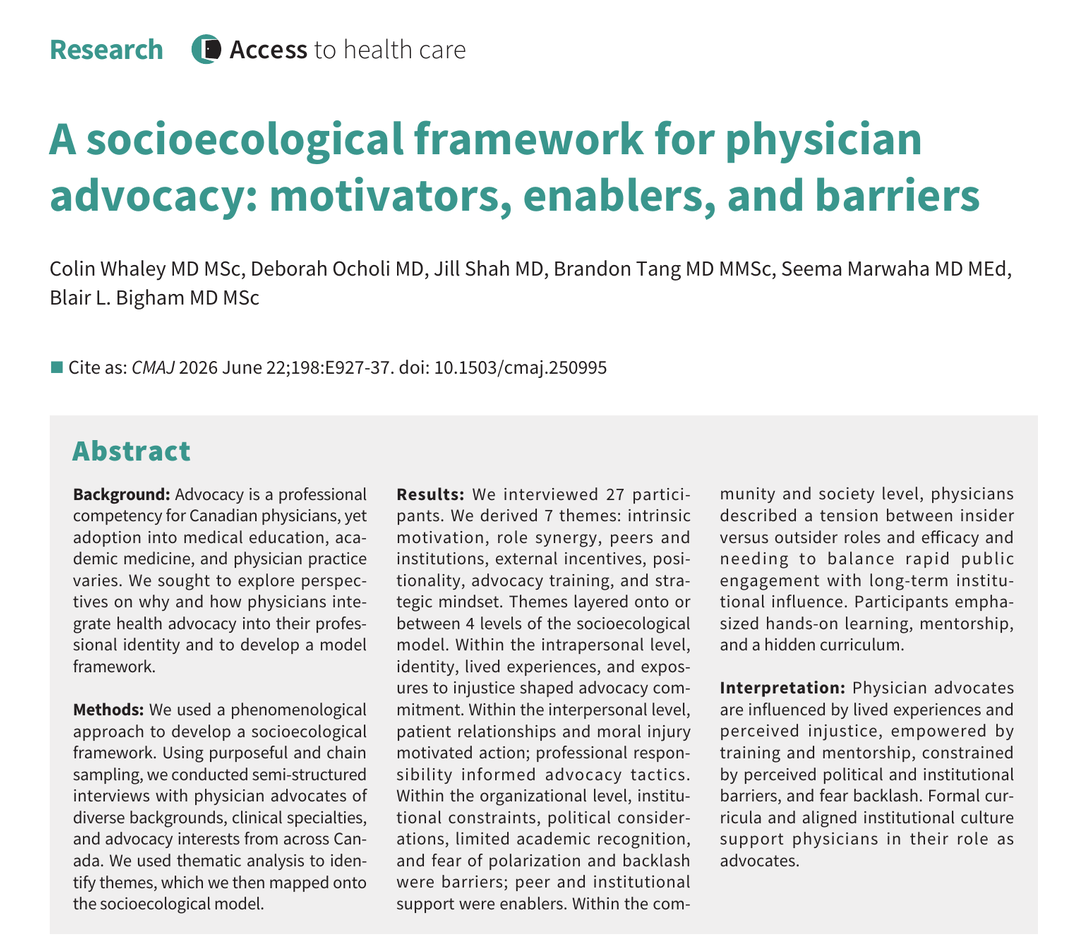
This qualitative study interviewed 27 physician advocates from across Canada, sampled to span provinces and territories, specialties, career stage, and rural and urban practice. Thematic analysis produced seven themes, which the team mapped onto the four
levels of the socioecological model and the interactions between adjacent levels.
What we found
Intrapersonal — Advocacy commitment is rooted in upbringing, identity, lived experience, and early exposure to injustice. Several participants described advocacy as protective against moral injury and burnout.
Interpersonal — Clinical practice is the foundation of an advocate's credibility. Participants moved deliberately between "insider" roles, which carry levers but constrain speech, and "outsider" roles, which carry freedom but less direct power.
Organizational — Institutions were the most consistently named barrier: political sensitivity, risk aversion, and the absence of academic recognition for advocacy work. Peer and institutional sponsorship were the corresponding enablers.
Community and society — Participants described balancing rapid public engagement against slower institutional influence, and weighed the reputational risk of speaking publicly against the reach it buys.
Participants pointed to a hidden curriculum in which stated competency expectations and lived professional reality diverge, and endorsed early experiential training, structured curricula, and mentorship as the fix.
Citation
Whaley C, Ocholi D, Shah J, Tang B, Marwaha S, Bigham BL. A socioecological framework
for physician advocacy: motivators, enablers, and barriers. CMAJ.
2026;198(24):E927-37. doi:10.1503/cmaj.250995
Open access under CC BY-NC-ND 4.0.